Every goal backed by research.
Every recommendation evidence-based.
Most nutrition apps pull numbers out of thin air. Acai doesn’t. Every daily target, every micronutrient goal, every recommendation maps back to peer-reviewed research and established RDA guidelines.
Goals rooted in peer-reviewed science, not guesswork
When Acai sets your daily iron target, it’s not a round number someone picked. It’s derived from the Recommended Dietary Allowance (RDA) established by the National Academies of Sciences, adjusted for your age, sex, and activity level.
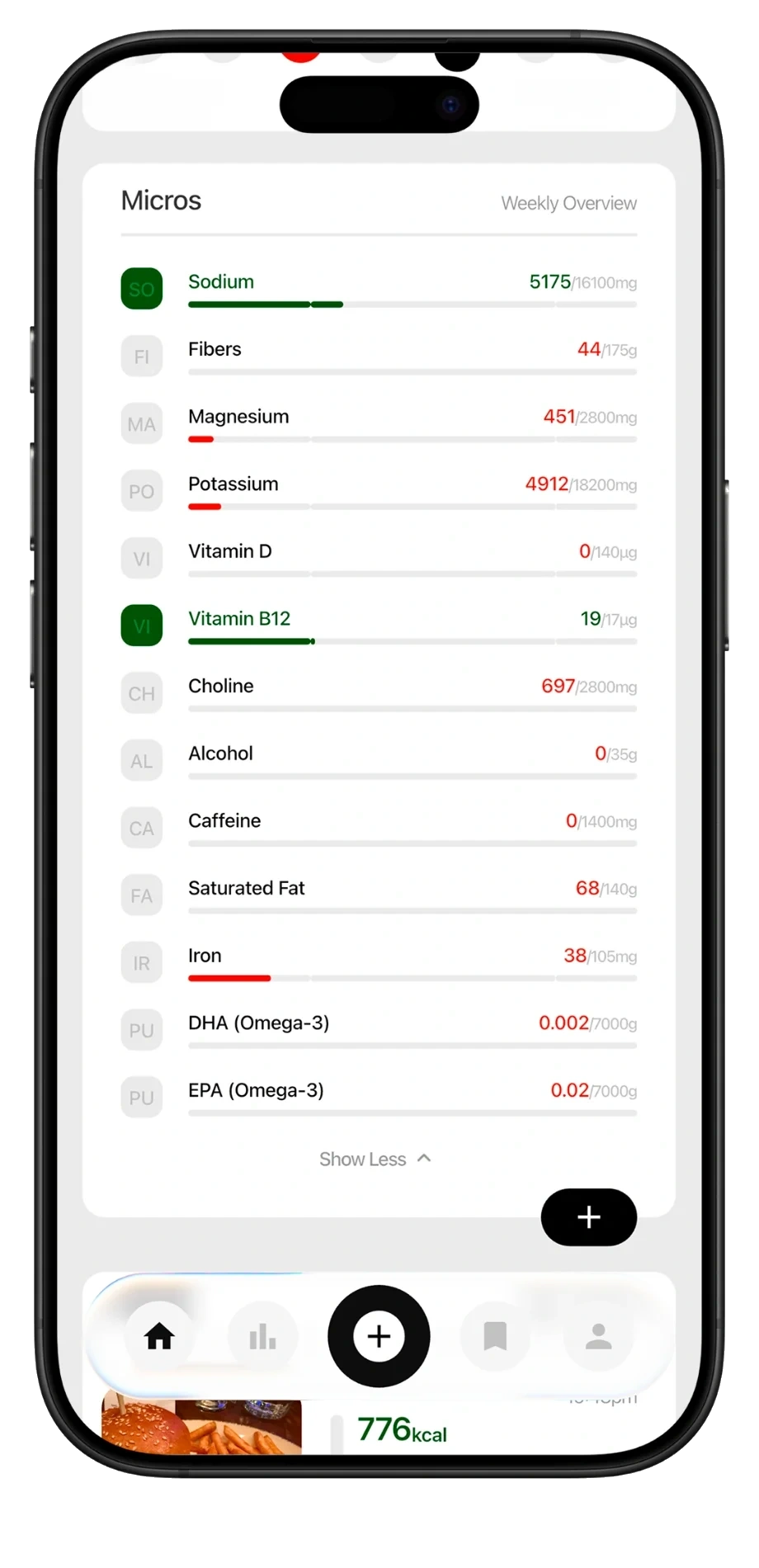
The same applies to every one of the 245 micronutrients Acai tracks. Vitamin D, magnesium, zinc, B12, folate, selenium, potassium — each goal is anchored to published dietary reference intakes. No arbitrary percentages. No made-up benchmarks.
This is the white space in nutrition tracking. Every other app gives you goals. Acai gives you goals you can trace back to the research.
Why tracking 245 micronutrients changes everything
Iron deficiency is the most common nutritional deficiency worldwide. Most people don’t know they’re deficient until symptoms become severe — fatigue, brain fog, weakened immunity.
Nearly half of the U.S. population doesn’t get enough vitamin D — linked to weakened bones, impaired immune function, and increased risk of chronic disease. Yet most trackers don’t even show it.
Magnesium is involved in over 300 enzymatic reactions. Half the population isn’t getting enough, contributing to muscle cramps, poor sleep, anxiety, and cardiovascular risk. You can’t fix what you can’t see.
Calorie counting tells you how much you ate. Macro tracking tells you the rough proportions. But micronutrient tracking tells you whether your body actually has what it needs to function. That’s why Acai tracks all 245 — because the gaps you don’t see are the ones that hurt you.
Built from scratch. Not a wrapper on someone else’s AI.
Acai’s food recognition engine is proprietary — not built on ChatGPT, Gemini, or any third-party vision API. Every parameter was trained specifically for one task: looking at food and understanding exactly what’s in it.
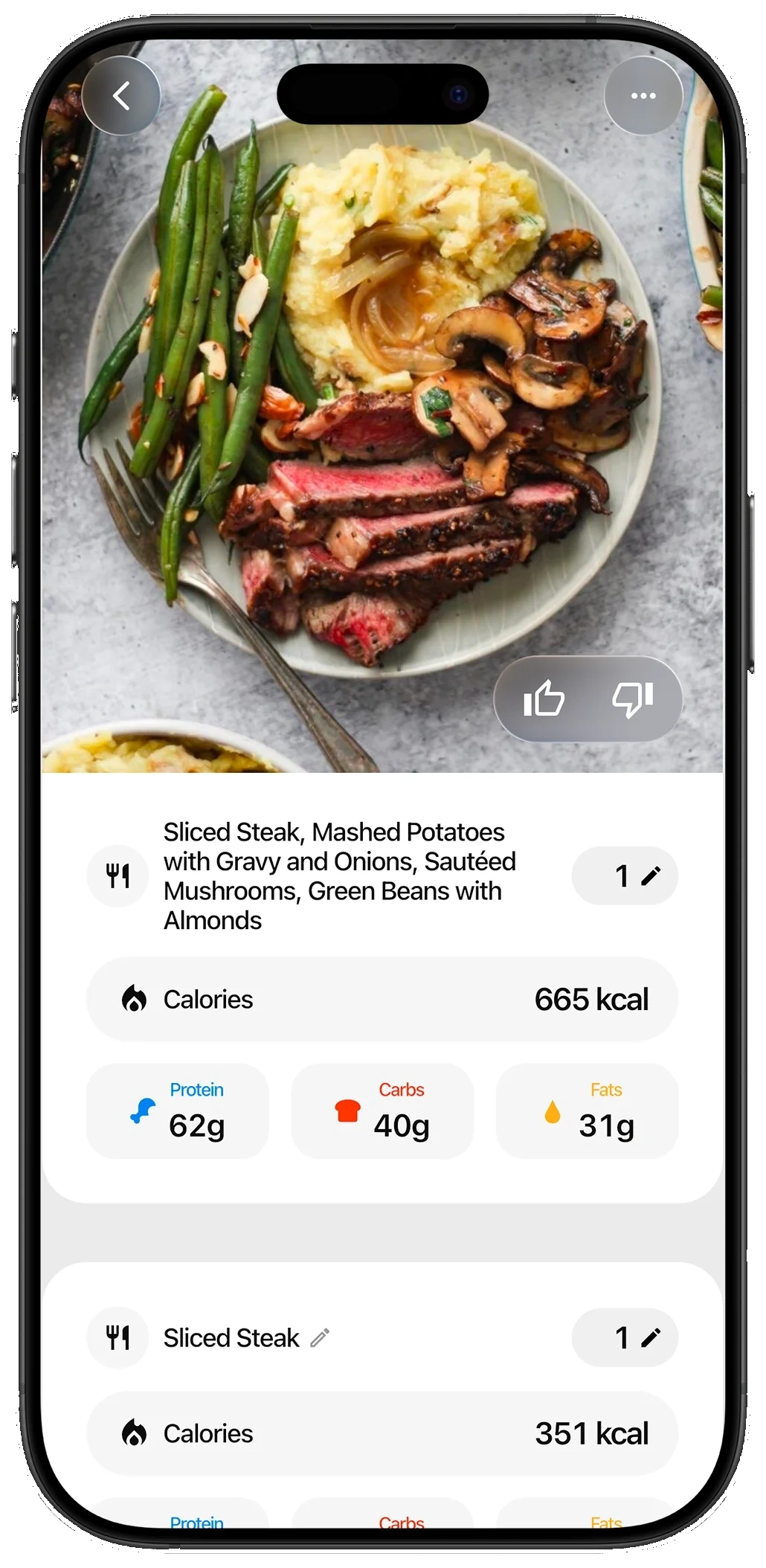
When you photograph a meal, the AI performs ingredient-level identification — isolating each component on the plate, estimating portion sizes, and cross-referencing against a structured nutritional database to calculate precise values for all 245 tracked nutrients.
This isn’t “chicken salad = 350 calories.” It’s: grilled chicken breast (140g), mixed greens (85g), cherry tomatoes (45g), olive oil dressing (15ml) — each with its own complete nutritional profile.
93 kcal MAE. Tested on 10,000+ real meals.
Real-world testing
Our benchmark dataset spans over 10,000 real-world meal photographs — restaurant dishes, home-cooked meals, snacks, smoothies, multi-ingredient plates. Not stock photos. Not simple single-ingredient items. The messy, complicated meals people actually eat.
Mean Absolute Error
93 kcal MAE means that on average, Acai’s estimate is within 93 calories of the actual value. For a 600-calorie meal, that’s a range of 507 to 693 — precise enough to make real dietary decisions with confidence.
Outperforms general-purpose AI
ChatGPT averages 170 kcal error. Gemini averages 470 kcal error. General-purpose models weren’t built for nutrition — they guess. Acai was purpose-built to measure.
Transparent methodology
We publish our accuracy numbers because we’re confident in them. Most nutrition apps don’t share accuracy data at all — because they don’t have proprietary AI to benchmark.
Every scan makes the model better
Acai’s AI doesn’t sit still. Every scan, every correction, every piece of user feedback feeds back into the model. The accuracy numbers you see today are already better than they were last month — and they’ll be better next month than they are today.
This is the fundamental advantage of a purpose-built system. ChatGPT and Gemini update on their own schedules, for their own priorities. Acai’s model evolves specifically to improve nutritional accuracy — because that’s the only thing it needs to do.
The more people use Acai, the smarter it gets. The smarter it gets, the more accurate your tracking becomes. It’s a virtuous cycle that no general-purpose AI can replicate.
Science-backed nutrition tracking.
Finally.
245 micronutrients. 93 kcal accuracy. Every goal traceable to peer-reviewed research. Stop guessing. Start knowing.